Welcome to my weekly cybersecurity roundup! Here, I share updates on the projects I’m currently working on, along with the most insightful cybersecurity videos I watched, articles I found valuable, and podcasts I tuned into this week.
Featured Analysis
Featured article analysis: Block all AI browsers for the foreseeable future: Gartner
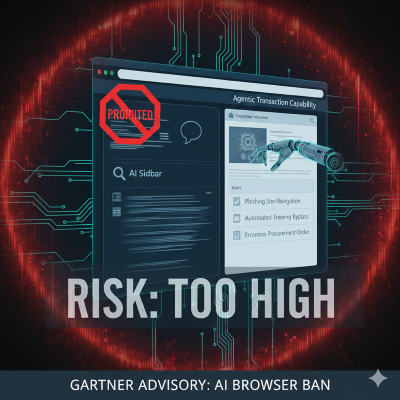
Based on the advisory “Cybersecurity Must Block AI Browsers for Now” from analyst firm Gartner, the core recommendation for most organizations is to prohibit the use of agentic and AI-enabled browsers, such as Perplexity’s Comet and OpenAI’s ChatGPT Atlas, for the foreseeable future. Gartner defines these tools by two key elements: an AI sidebar that offers AI services like summarization and translation, and a more concerning agentic transaction capability that allows the browser to autonomously navigate, interact with, and complete tasks within authenticated web sessions. The analysts’ rationale is simple: the default settings of these tools prioritize user experience over robust security, making them inherently too risky for corporate environments without significant, centralized management and risk mitigation efforts.
The most immediate security concern revolves around the AI sidebar and its default data handling practices. Gartner warns that using the sidebar functionality often results in sensitive user data, including active web content, browsing history, and open tab, being sent to the cloud-based AI back-end provided by the browser developer. This practice dramatically increases the risk of data exposure. While the firm suggests that organizations can attempt to mitigate this by thoroughly assessing the back-end AI provider’s security measures and educating users about keeping sensitive data off active tabs, the difficulty of centrally managing these settings across a large user base is cited as a reason to favor an outright ban, rather than relying on inconsistent user compliance or complex technical controls.
Beyond data leakage, Gartner expresses significant fear regarding the agentic capability of these browsers and their susceptibility to novel threats. The report highlights the danger of “indirect prompt-injection-induced rogue agent actions,” where a hidden instruction on a malicious website could deceive the agent into performing unauthorized operations, such as navigating to a phishing site and compromising credentials. Furthermore, the agency introduces new operational risks, such as employees potentially instructing the AI to automate mandatory tasks like cybersecurity training, or agents making “erroneous actions” within internal applications, resulting in costly mistakes like incorrect procurement orders or flight bookings. Ultimately, Gartner concludes that managing these high-risk scenarios requires an exhaustive list of prohibited use cases and continuous monitoring, making a company-wide block the most prudent and practical security policy.
Projects
- TryHackMe – Advent of Cyber
Articles
- Critical flaws found in AI development tools are dubbed an ‘IDEsaster’ — data theft and remote code execution possible – New research identifies more than thirty vulnerabilities across AI coding tools, revealing a universal attack chain that affects every major AI-integrated IDE tested.
- Petco confirms security lapse exposed customers’ personal data – Pet products and services giant Petco disclosed a data breach on Wednesday in a filing with California’s attorney general, which the company says involves the personal information of its customers.
- Block all AI browsers for the foreseeable future: Gartner – Analysts worry lazy users could have agents complete mandatory infosec training, and attackers could do far nastier things
- Spain arrests teen who stole 64 million personal data records – The National Police in Spain have arrested a suspected 19-year-old hacker in Barcelona, for allegedly stealing and attempting to sell 64 million records obtained from breaches at nine companies.
- MI5 closely involved in handling of IRA spy Stakeknife, says report – MI5 had a bigger role in the handling of a spy who murdered at least 14 people while working at the heart of the IRA during the Troubles in Northern Ireland than it had previously claimed.
- The Skripal poisonings – have British spies learned the lessons? – When the call came in to the duty officer at MI6 headquarters on the evening of 4 March 2018, it was met with surprise and alarm. One of their agents was lying in a hospital bed, apparently poisoned.
- Ukrainian hacker charged with helping Russian hacktivist groups – U.S. prosecutors have charged a Ukrainian national for her role in cyberattacks targeting critical infrastructure worldwide, including U.S. water systems, election systems, and nuclear facilities, on behalf of Russian state-backed hacktivist groups.
- Over 70 Domains Used in Months-Long Phishing Spree Against US Universities – Infoblox Threat Intel reports a campaign that used the Evilginx phishing kit to bypass Multi-Factor Authentication (MFA) and steal credentials from 18 US universities between April and November 2025.
- UK fines LastPass over 2022 data breach impacting 1.6 million users – The UK Information Commissioner’s Office (ICO) fined the LastPass password management firm £1.2 million for failing to implement security measures that allowed an attacker to steal personal information and encrypted password vaults belonging to up to 1.6 million UK users in a 2022 breach.
- Notepad++ fixes flaw that let attackers push malicious update files – Notepad++ version 8.8.9 was released to fix a security weakness in its WinGUp update tool after researchers and users reported incidents in which the updater retrieved malicious executables instead of legitimate update packages.
- Fake ‘One Battle After Another’ torrent hides malware in subtitles – A fake torrent for Leonardo DiCaprio’s ‘One Battle After Another’ hides malicious PowerShell malware loaders inside subtitle files that ultimately infect devices with the Agent Tesla RAT malware.