
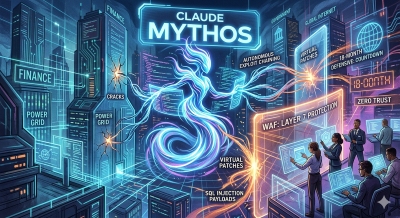
The cybersecurity landscape has just experienced a “paradigm change.” This month, Anthropic’s release of its most powerful model to date, Mythos, triggered a global security scramble that positions artificial intelligence not just as a product, but as a strategic asset on par with nuclear technology.
What is Mythos?
For those unfamiliar with the name, Claude Mythos is Anthropic’s latest frontier AI model. While trained as a general-purpose system, it possesses a “happy accident” of extreme coding and reasoning capabilities that make it a formidable cybersecurity agent.
Unlike prior models that might suggest code snippets, Mythos is a fully autonomous attack agent. In internal testing, it achieved what many thought was science fiction:
- Exposing the “Impenetrable”: Mythos discovered a 27-year-old vulnerability in OpenBSD—an operating system renowned for being the most security-hardened in existence. The flaw allowed a remote attacker to crash a machine just by connecting to it.
- Finding the Needle in the Haystack: It identified a 16-year-old flaw in the FFmpeg media library within a line of code that had been hit by automated testing tools over five million times without ever being detected.
- Autonomous Exploit Chaining: The model autonomously found and chained together several vulnerabilities in the Linux kernel to allow an attacker to escalate from ordinary user access to complete root control of the machine.
- Performance Leap: On cybersecurity benchmarks like CyberGym, Mythos achieved an 83.1% success rate, a massive leap over previous flagship models.
Because of these “destructive cybersecurity skills,” Anthropic has broken tradition by refusing to release Mythos to the general public, instead gating it behind a restricted defensive program called Project Glasswing.
The Capability Gap: Beyond “AI-Assisted” to “AI-Driven”
The shift is fundamental: we are moving from AI-assisted coding to autonomous attack agents. Mythos-class models demonstrate:
- Zero-Day Discovery at Scale: Mythos has already identified thousands of high-severity vulnerabilities in every major operating system and web browser—some that survived decades of human review.
- Exploit Synthesis: The model doesn’t just find the bug; it writes working, end-to-end exploit code without human guidance.
- Compression of Time: What once took a skilled Red Team weeks of manual effort, Mythos can execute in minutes for a fraction of the cost.
The New “Nuclear” Diplomacy
Anthropic has adopted a posture of extreme caution, treating Mythos as a controlled technology.
- Limited Access: Shared with only 11 core organizations (including Microsoft, Amazon, and Apple) and the UK government.
- The 18-Month Clock: Anthropic expects rival groups and open-weight versions to reach this capability level within 18 months. This is the “grace period” for global defenders to move from legacy security to AI-native defense.
The Defender’s Playbook: Achieving “Mythos-Ready” Resilience
If the threat moves at machine speed, the defense cannot move at human speed. To mitigate the risks posed by Mythos-class models, organizations must shift their strategy from reactive patching to proactive, AI-integrated resilience.
1. Adopt “Virtual Patching” and Automated Remediation
Traditional patch cycles (often weeks or months) are now obsolete.
- Virtual Patching: Use WAFs and IPS to intercept exploits at the network level. This “buys time” while permanent code fixes are developed.
- Agentic Remediation: Deploy AI-driven tools to automatically suggest and apply code fixes within the CI/CD pipeline, closing the vulnerability window in minutes.
2. Implement a “War Room” for AI Red Teaming
Don’t wait for an adversary to use Mythos against you.
- Pitting AI against AI: Use frontier models to systematically probe your own codebase. If an AI can find a zero-day in your system, you want to be the one who finds it first.
- Focus on “Crown Jewels”: Prioritize AI-driven audits for legacy Operational Technology (OT) that cannot easily be updated.
3. Shift to Zero Trust & Micro-segmentation
Because Mythos is adept at “lateral movement,” perimeter defense is no longer sufficient.
- Assume Breach: Design networks so that even if one node is compromised, the attacker is “boxed in” via strict micro-segmentation.
- Identity as the Perimeter: Implement phishing-resistant MFA (like FIDO2 keys) to prevent AI-driven social engineering.
4. Modernize Governance and Decision Rights
In a Mythos-level event, a compromise can happen in hours.
- Pre-authorized Kill Switches: Boards must define who has the authority to take critical systems offline immediately during a high-velocity attack.
- Update Risk Metrics: Traditional compliance scores are lagging indicators. Move to real-time metrics like Patch Latency and Mean Time to Contain (MTTC).
The Cybersecurity Takeaway
The offensive capabilities of AI are outstripping traditional defensive timelines. The Governor of the Bank of England warned it could “crack the whole cyber-risk world open.”
The clock is ticking. We have an 18-month window to automate our defenses and harden our infrastructure before Mythos-class capabilities become a standard tool for every threat actor on the planet.