
What is the DBIR?
For nearly two decades, the security community has anticipated a single annual landmark document to cut through vendor hype and deliver data-driven reality: the Verizon Data Breach Investigations Report (DBIR). Initiated in 2008 as a longitudinal study analyzed by Verizon’s data scientists, the report has evolved from an initial examination of a few hundred incidents into a massive global framework. By gathering anonymized, normalized telemetry from scores of global cyber insurance firms, forensic teams, and law enforcement agencies, the DBIR translates chaotic security incidents into statistical clarity using the open-source VERIS framework. It remains arguably the single most important document in corporate cybersecurity, validating where defenses are holding firm and pinpointing where adversaries are successfully pivoting.
Unprecedented Scale and Fundamental Shifts
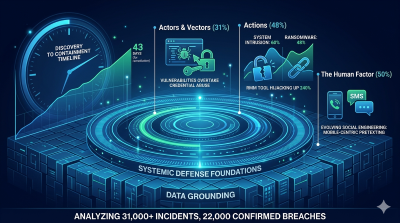
The newly released 19th edition of the DBIR offers an expansive look at the threat landscape, analyzing a staggering corpus of more than 31,000 real-world security incidents, including a record-breaking 22,000 confirmed data breaches across 145 countries. Amidst this information overload, the core takeaway from the 2026 report is clear: cybersecurity does not require an operational revolution, but rather a stubborn, disciplined refinement of fundamentals. While threat actors have aggressively scaled their execution speeds, the overarching theme centers on “keeping a strong foundation in the face of change”. The report warns that adversaries have integrated new operational workflows, such as Generative AI (GenAI), to dramatically accelerate vulnerability discovery, target selection, and custom malware optimization, forcing defenders to match this rapid execution scale without losing sight of basic hygiene.
Vulnerabilities Take the Crown
When slicing the dataset through the VERIS “Actors” and “Actions” pillars, a historic shift has occurred in initial access dominance. External actors continue to heavily drive the threat landscape, accounting for 88% of confirmed breaches, with organized criminal syndicates dominating the data via systematic, repeatable monetization tactics. Strikingly, the exploitation of vulnerabilities has dethroned credential abuse as the number-one vector for initial corporate entry, skyrocketing to 31% of breaches in the reporting dataset. This spike is severely exacerbated by defender fatigue: organizations only fully remediated 26% of critical vulnerabilities found on the CISA Known Exploited Vulnerabilities (KEV) catalog during the cycle, down from 38% the previous year. Furthermore, the median time to fully resolve a critical vulnerability has slipped to 43 days, giving opportunistic attackers an expanded window to strike.
The Evolution of System Intrusion, Ransomware, and the Third-Party Web
Once inside an environment, adversaries continue to favor complex System Intrusion patterns, which now account for 60% of all analyzed breaches. Ransomware remains the primary driving engine behind these intrusions, appearing in 48% of total breaches. However, the report highlights an intriguing silver lining: a massive 69% of ransomware victims ultimately refused to pay, forcing the median ransom payment downward to $139,875. Because monetization has gotten harder, threat actors are heavily adjusting their operational tactics. Instead of deploying custom backdoors or recognizable Command and Control (C2) frameworks that modern endpoint tools easily catch, attackers are increasingly hijacking legitimate Remote Monitoring and Management (RMM) software. By acting as an “unapproved administrator” via these whitelisted RMM tools, a technique that grew a stunning 240% year-over-year, attackers are effortlessly blending in with legitimate daily operations. This operational pivoting is highly tied to systemic third-party dependencies; breaches involving a compromised third-party software or service relationship expanded by 60%, accounting for nearly half (48%) of all corporate data breaches.
Social Engineering Moves Beyond the Inbox
Despite the surge in automated vulnerability scanning, the human element remains a primary pivot point, maintaining an insidious presence across roughly half of global breaches. Social Engineering tactics are rapidly evolving past traditional email phishing. The 2026 data shows an intense spike in real-time, synchronous Pretexting, with threat actors utilizing mobile-centric communications, SMS, and direct voice calls to catch corporate help desks and customer support agents off guard mid-workday. Because human manipulation has become highly interactive, traditional, checkbox-style email phishing simulators are no longer sufficient. Organizations must develop rigid, business-oriented verification workflows specifically designed to protect IT help desks from being socially engineered into resetting access credentials or altering administrative permissions.
The Defensive Blueprint
For cybersecurity enthusiasts and enterprise leaders alike, the 2026 DBIR clarifies exactly where defensive budgets must go. Security teams cannot stop sophisticated, GenAI-accelerated campaigns if they cannot master basic infrastructure management. Security leadership must prioritize sharp, visibility-focused asset and third-party risk management, rigid patch prioritization based on active threat intelligence rather than just CVSS scores, and deeply practiced incident response drills. As third-party infrastructure and identity vectors continue to fuse, defensive postures do not need to be reinvented, they simply need to be executed with strict, unyielding discipline to narrow the window of opportunity before the next exploit hits.