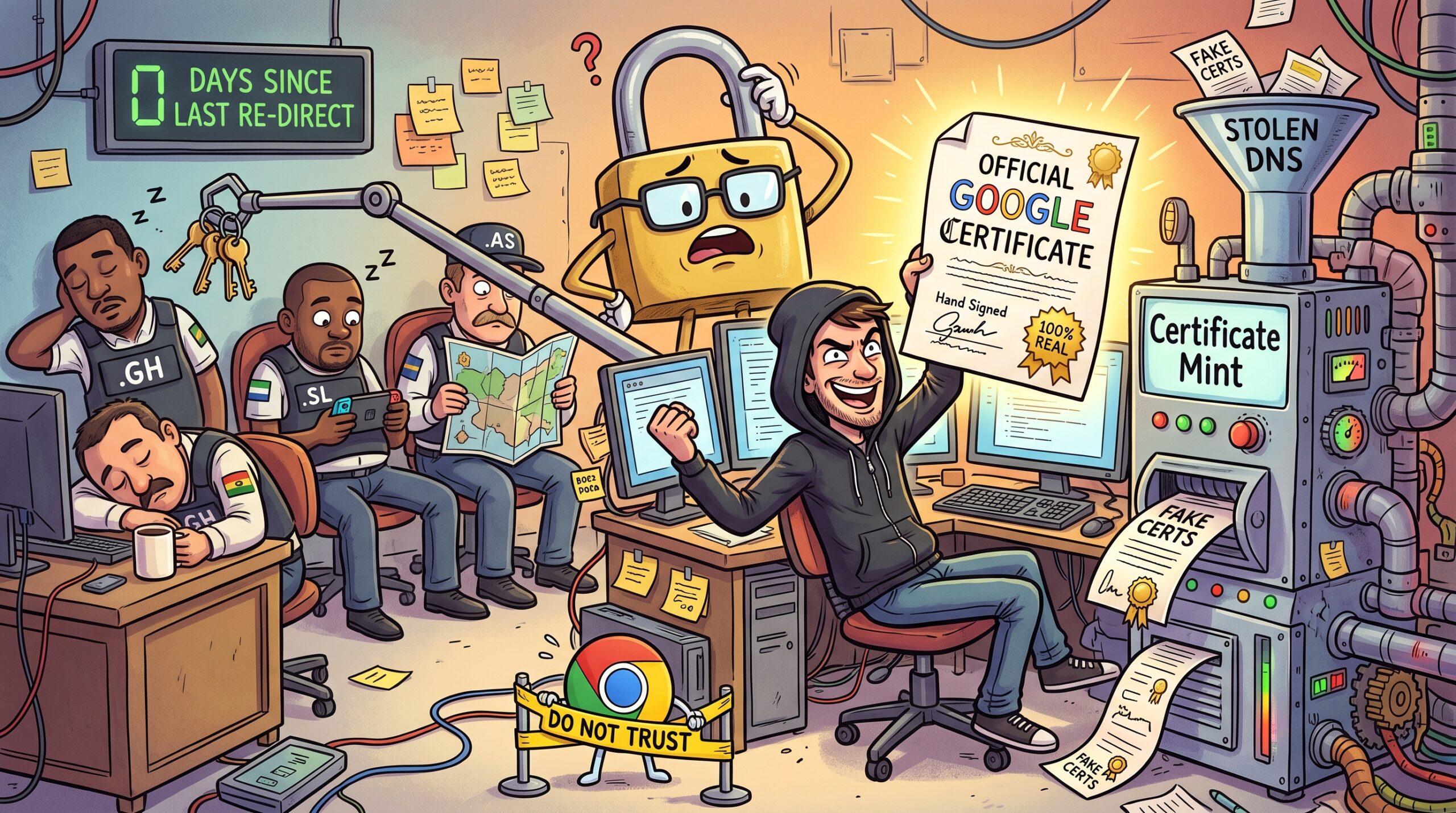
A recent report from Ars Technica breaks down a critical incident where attackers managed to generate valid digital security certificates for high-profile domains without breaking into the companies’ actual servers. The attackers compromised three country-code domain registries (.gh, .sl, and .as) and modified the authoritative Domain Name System (DNS) records. Because certificate authorities rely on automated checks to confirm that an applicant controls a domain before handing out a certificate, poisoning these registry records allowed the attackers to pass validation easily. This granted them unauthorized certificates for “several Google domains” alongside “several leading global brands and widely used online services.”
To understand why this matters, think of a TLS certificate as an authentic digital passport for a website. It proves the site is who it claims to be and encrypts the connection between the user and the server. As the report explains, “Possession of unauthorized certificates allows attackers to cryptographically impersonate the affected infrastructure.” When attackers hold a legitimate certificate, they can sit between a user and a real service, intercepting sensitive logins or decrypting private data, all while the visitor’s browser displays a trusted padlock icon with zero security warnings.
Even though Google acted quickly to block rogue certificates inside Chrome and revoke its own keys, client-side fixes have clear boundaries. The traditional revocation system that tells browsers a certificate is no longer trustworthy is slow and inconsistent across the internet. Google noted this exact limitation, warning that “Due to the complexity of DNS hijacks, we cannot guarantee that our analysis identified every affected domain, nor do Chrome interventions reliably protect non-Chrome users.” Anyone connecting through other web browsers, mobile apps, or backend API scripts could still be fooled by an undiscovered, fraudulent certificate.
This attack highlights why security teams cannot focus entirely on securing endpoint servers while ignoring the external trust chain. Defending against registry tampering requires layers of proactive monitoring. Organizations must track Certificate Transparency (CT) logs, which act like public ledgers recording every certificate issued worldwide, so rogue creations get spotted immediately. Additionally, teams should enforce Certification Authority Authorization (CAA) DNS records, which explicitly tell the internet which certificate authorities are allowed to issue certificates for a specific domain name.
Projects
- SANS SEC504 (aka GCIH)
- TryHackMe
Articles
- MI5 Says China’s MSS Funded Research Involving 100+ U.K.-Linked Academics – The U.K.’s domestic intelligence and security agency has warned that more than 100 academics have helped China boost its intelligence gathering efforts on behalf of Beijing’s state security service.
- ShinyHunters hacker reportedly detained in Jordan, aiding FBI – A suspected ShinyHunters hacking group member known online as “Rey” has reportedly been detained in Jordan and is cooperating with the FBI to help locate other members of the extortion group.
- Hacks of 2 federal agencies in a month have spilled a bonanza of sensitive data – It has been a bad month for federal government cybersecurity.
- Suspected Chinese spies spoofed an Anthropic exec, ex-White House official in AI phishing – Your invite to a fake AI policy advisory committee has strings attached
- Police Arrest 16-Year-Old Suspected of Running KillSec, Seize Ransomware Leak Site and Servers – Police in Spain have arrested a 16-year-old whom investigators suspect of running the KillSec ransomware group. KillSec is accused of stealing data from organizations and threatening to publish it on its leak site unless they paid.
- Denmark population registry data breach affects 8.8 million people – Denmark’s Central Population Register (CPR) is warning of a data breach that exposed the personal information of approximately 8.8 million registered individuals.
- FBI Removes Accenture Contractor After Patch Failure Led to ShinyHunters Breach – The U.S. Federal Bureau of Investigation (FBI) has removed an Accenture contractor for their alleged role in a ShinyHunters-breach that led to the theft of personal details of thousands of bureau employees.
- Engineer sentenced for locking over 3,000 devices on employer network – A former core infrastructure engineer at an industrial company headquartered in New Jersey was sentenced to 32 months in prison for locking thousands of devices on his employer’s network in a ransomware-style attack.
- Wikimedia: Rogue OpenAI agents behind unauthorized Wikipedia edits – The Wikimedia Foundation says rogue OpenAI agents made unauthorized Wikipedia edits and may have been partially responsible for a May outage.
- Your car is a smartphone on wheels. Here’s who’s listening – The first large-scale measurement study of the connected-vehicle ecosystem.
- Personal Information for Over 1 Million People Stolen in a Cyberattack on Arizona’s Court System – The Arizona Supreme Court said the information was copied for people dating back as far as 30 years.
- Musician sent to prison for $10 million streaming fraud using AI bots – A North Carolina musician was sentenced to 18 months in prison for collecting more than $10 million in royalties from Spotify, Apple Music, Amazon Music, and YouTube Music in a massive streaming royalty fraud scheme.
- Hackers obtain counterfeit TLS certificates for Google and other large services – Compromise of 3 domain registries allows hackers to walk off with unauthorized certs.
- FBI Says China-Linked Hackers Ran Portal Giving Third Parties Access to Stolen Emails – Hackers tied to a Chinese cybersecurity company stole email from government organizations, law enforcement agencies, healthcare systems, and religious institutions in Southeast Asia, the FBI and agencies in 6 other countries said on October 8.
- FBI arrests another suspected ShinyHunters hacker after agency breach – The FBI has arrested another suspected member of the ShinyHunters extortion group believed to be involved in the recent breach of FBI systems, Director Kash Patel announced Friday.