

Welcome to my weekly cybersecurity roundup! Here, I share updates on the projects I’m currently working on, along with the most insightful cybersecurity videos I watched, articles I found valuable, and podcasts I tuned into this week.
Demystifying 802.1X and the IEEE Wireless Landscape
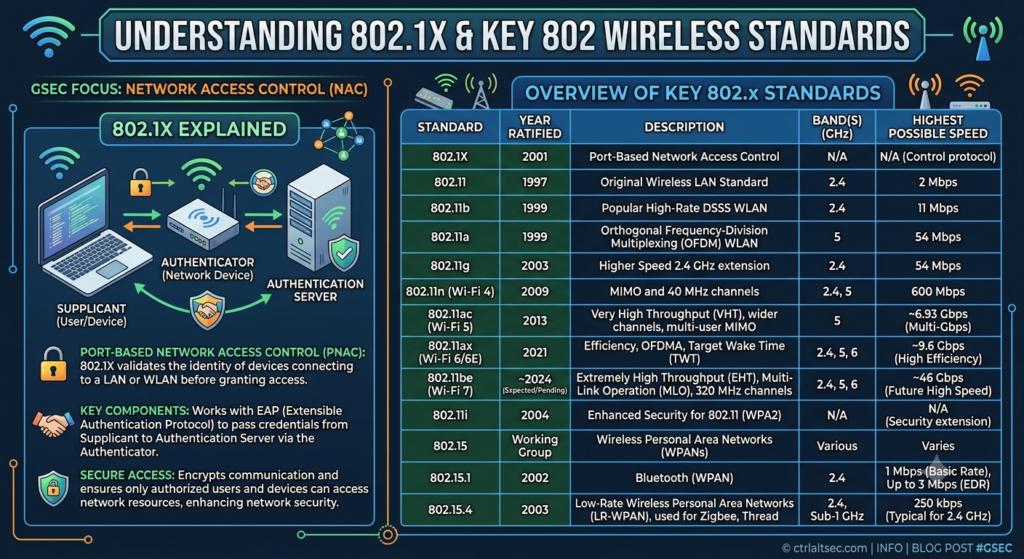
To celebrate the kickoff of my GIAC Security Essentials (GSEC) class this week, we are stripping enterprise networking down to its foundation and exploring a critical security control that serves as an infrastructure’s frontline gatekeeper: IEEE 802.1X. Simply put, 802.1X is an IEEE standard for port-based Network Access Control (PNAC). It provides a secure, identity-based authentication framework for devices attempting to attach to a wired local area network (LAN) or a wireless network (WLAN). Before a connecting machine is assigned an IP address or permitted to pass regular network traffic, 802.1X steps in at the Data Link layer (Layer 2) to verify its identity, ensuring that rogue or unauthenticated devices are blocked right at the point of access.
Under the hood, the brilliance of 802.1X lies in its standardized architectural components, which divide the network entry process into three distinct roles: the Supplicant, the Authenticator, and the Authentication Server. The Supplicant is the client device or software agent (like your workstation or smartphone) requesting network entry. The Authenticator is the perimeter edge device—typically a managed network switch or a wireless access point (WAP), that acts as a strict physical gatekeeper, dropping all non-authentication traffic until permission is explicitly granted. Finally, the Authentication Server (most commonly an enterprise RADIUS server) is the central brain containing the user or device database. These three entities communicate using the Extensible Authentication Protocol (EAP), securely passing credentials or digital certificates across the wire.
Implementing 802.1X is a monumental upgrade over relying on static, easily compromised pre-shared keys (PSKs) or wide-open ethernet jacks. By tying network admission directly to authenticated identities, organizations can implement context-aware defenses. Beyond a simple “allow or deny” response, modern 802.1X deployments empower security teams to leverage role-based access control and dynamic VLAN assignment. This means an internal corporate laptop, an executive’s personal tablet, and an untrusted IoT sensor can connect to the exact same physical switch or access point, yet automatically be segregated into completely isolated network segments based on their authentication profile. As we dive deeper into our GSEC path, tools like 802.1X remind us that robust Zero Trust architectures must always validate at the outermost edge.
Projects
- TryHackMe – AI/ML Security Threats – In Progress
Videos
Articles
- Charter Communications confirms data breach as hackers threaten leak of 42 million records – In a statement earlier today to CyberInsider, Charter Communications has confirmed a cybersecurity incident after the ShinyHunters extortion group claimed it breached the telecommunications giant and stole 42 million records of user data.
- Lithuania Suspects Foreign Involvement in Data Leak of Over 600,000 National Register Entries – Lithuanian authorities are on high alert after a massive data leak involving more than 600,000 entries from national data registers.
- Former US execs plead guilty to aiding tech support scammers – Two former executives of a call-tracking and analytics company pleaded guilty to concealing a years-long tech support fraud scheme that victimized individuals worldwide.
- FBI: Hackers Sending Operatives in Person to Insert USB Drives and Steal Data – The FBI has issued an alert warning of Silent Ransom Group attacks targeting law firms.
- LA Metro Cyberattack Linked to Iranian State-Sponsored Hackers – The attack was claimed by a hacktivist group, but evidence showed it used infrastructure linked to Iranian government threat actors.
- Romanian Hacker Sentenced to Prison in US for Selling Access to State Network – Catalin Dragomir previously pleaded guilty to selling access to an Oregon state government office’s network.
- Carnival Cruise confirms data breach affecting nearly 6 million people – Carnival Corporation, the world’s largest cruise line operator, has confirmed a data breach affecting nearly 6 million people claimed by the ShinyHunters extortion gang in April 2026.
- Russian Hacker Used Jailbroken Gemini to Steal Admin Credentials and Drain Crypto Wallets – A solo Russian-speaking threat actor leveraged a jailbroken instance of Google Gemini to run a five-year MAGA-themed influence operation, crack WordPress administrator credentials, and empty at least one victim’s cryptocurrency wallet, all at near-zero cost using stolen API keys.
- UK Visa Portal website leaks thousands of user passport data and photos online – 100,000 documents allegedly leaked.
- Romanian Hacker Gets Nearly 5 Years in US Prison Over Network Intrusion – Romanian hacker Catalin Dragomir (45) got 4 years and 8 months in prison for selling access to an Oregon state network.
- Russia-Linked ‘GreyVibe’ Attackers Use AI to Supercharge Cyberattacks – Researchers warn GreyVibe’s extensive use of ChatGPT, Gemini, and other AI tools offers a glimpse into how future cybercriminal and state-aligned groups will operate.
- GreyVibe hackers use ChatGPT, Gemini to power cyberattacks – A likely Russian threat group tracked as GreyVibe has been using AI-generated lures and a rich set of custom malware tools to target entities in the military, government, civilian, and business sectors.
- Man sent to prison for selling data of 7 millions elderly Americans – A North Carolina man was sentenced to more than 10 years in prison for selling the personal information of over 7 million elderly Americans to Jamaican scammers.
- California Sues 23andMe, Alleging It Failed to Protect User Data in 2023 Breach – Attorney General Rob Bonta filed the lawsuit against Chrome Holding Co., which 23andMe rebranded under after filing for bankruptcy last March.
- A security lapse at prison pay phone service Pay Tel publicly exposed over 300K callers’ driver’s licenses