Welcome to my weekly cybersecurity roundup! Here, I share updates on the projects I’m currently working on, along with the most insightful cybersecurity videos I watched, articles I found valuable, and podcasts I tuned into this week.
Featured Analysis
Featured article analysis: FBI investigating hack on its wiretap and surveillance systems: Report
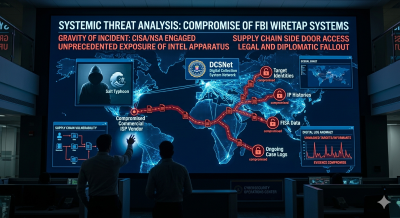
The reported hack of the FBI’s surveillance and wiretap systems, specifically the Digital Collection System Network, represents a staggering breach of national security infrastructure. By gaining access to a network responsible for managing court-authorized wiretaps and Foreign Intelligence Surveillance Act (FISA) warrants, the attackers widely suspected to be linked to Chinese state-sponsored groups like “Salt Typhoon” have potentially compromised the integrity of ongoing federal investigations. This breach likely exposed sensitive data, including incoming and outgoing calls, IP histories, and the identities of surveillance targets. The gravity of the incident is underscored by the involvement of the NSA, CISA, and the White House, signaling that this was not a localized failure but a systemic threat to the American intelligence apparatus.
Technically, the incident highlights a critical vulnerability in the U.S. government’s “supply chain” security. Rather than launching a direct frontal assault on the FBI’s hardened internal defenses, the hackers reportedly exploited a third-party commercial internet service provider (ISP) that serves as a vendor for the agency. By compromising the ISP, the attackers were able to blend their malicious activity with legitimate network traffic, effectively bypassing internal security tools designed to detect unauthorized access. This “side door” approach illustrates a sophisticated shift in cyber espionage, where state actors target the weakest links in a trusted relationship to gain persistent, silent access to highly classified environments.
The broader implications of this breach extend to legal and diplomatic spheres, raising urgent questions about the protection of civil liberties and the stability of the U.S. judicial process. With investigation targets and confidential informants potentially unmasked, the FBI faces the dual challenge of neutralizing the threat while managing the fallout of compromised evidence in criminal trials. Lawmakers have used the incident to renew calls for stricter cybersecurity mandates for telecommunications providers, arguing that the historical lack of federal oversight has allowed foreign adversaries to “burrow” into the nation’s communications backbone. Ultimately, the hack serves as a sobering reminder that the systems designed to monitor threats can themselves become the most dangerous tools in the hands of an adversary.
This FBI wiretap breach analysis provides additional context on how the hackers managed to access the sensitive network and the potential impact on national security.
Projects
Articles
- US Cyber Strategy Targets Adversaries, Critical Infrastructure, and Emerging Technologies – Trump’s Cyber Strategy calls for stronger deterrence against cyber adversaries, modernization of federal networks, protection of critical infrastructure, and investment in technologies such as AI and post-quantum cryptography.
- FBI warns of phishing attacks impersonating US city, county officials – The Federal Bureau of Investigation (FBI) warns that criminals are impersonating U.S. officials in phishing attacks targeting businesses and individuals who request city and county planning and zoning permits.
- Partnering with Mozilla to improve Firefox’s security – AI models can now independently identify high-severity vulnerabilities in complex software. As we recently documented, Claude found more than 500 zero-day vulnerabilities (security flaws that are unknown to the software’s maintainers) in well-tested open-source software.
- FBI investigating hack on its wiretap and surveillance systems: Report – Hackers have reportedly broken into the networks of the FBI.
- Ericsson US discloses data breach after service provider hack – Ericsson Inc., the U.S. subsidiary of Swedish networking and telecommunications giant Ericsson, says attackers have stolen data belonging to an undisclosed number of employees and customers after hacking one of its service providers.
- SIM Swaps Expose a Critical Flaw in Identity Security – SIM swap attacks exploit misplaced trust in phone numbers and human processes to bypass authentication controls and seize high-value accounts.
- Russia-backed hackers breach Signal, WhatsApp accounts of officials, journalists, Netherlands warns
- Insider threats could be the biggest risk your business faces this year – Malicious and negligent insiders are an equal risk today, report warns
- Your Insider Threat Problem Is Actually A Leadership Issue – surveillance tools alone can’t fix disengaged employees caused by poor management and toxic workplace environments.
- Defeating the deepfake: stopping laptop farms and insider threats – Trust is the most expensive vulnerability in modern security architecture. In recent years, the security industry has pivoted toward a zero trust model for networks — assuming breach and verifying every request
- Michelin Confirms Data Breach Linked to Oracle EBS Attack – The cybercriminals have leaked more than 300GB of files allegedly stolen from the tire giant.
- US military contractor likely built iPhone hacking tools used by Russian spies in Ukraine – A mass hacking campaign targeting iPhone users in Ukraine and China used tools that were likely designed by U.S. military contractor L3Harris.
- Starbucks discloses data breach affecting hundreds of employees – Starbucks has disclosed a data breach affecting hundreds of employees after threat actors gained access to their Starbucks Partner Central accounts.
- Fake enterprise VPN downloads used to steal company credentials – A threat actor tracked as Storm-2561 is distributing fake enterprise VPN clients from Ivanti, Cisco, and Fortinet to steal VPN credentials from unsuspecting users.