
Welcome to my weekly cybersecurity roundup! Here, I share updates on the projects I’m currently working on, along with the most insightful cybersecurity videos I watched, articles I found valuable, and podcasts I tuned into this week.
Featured Analysis
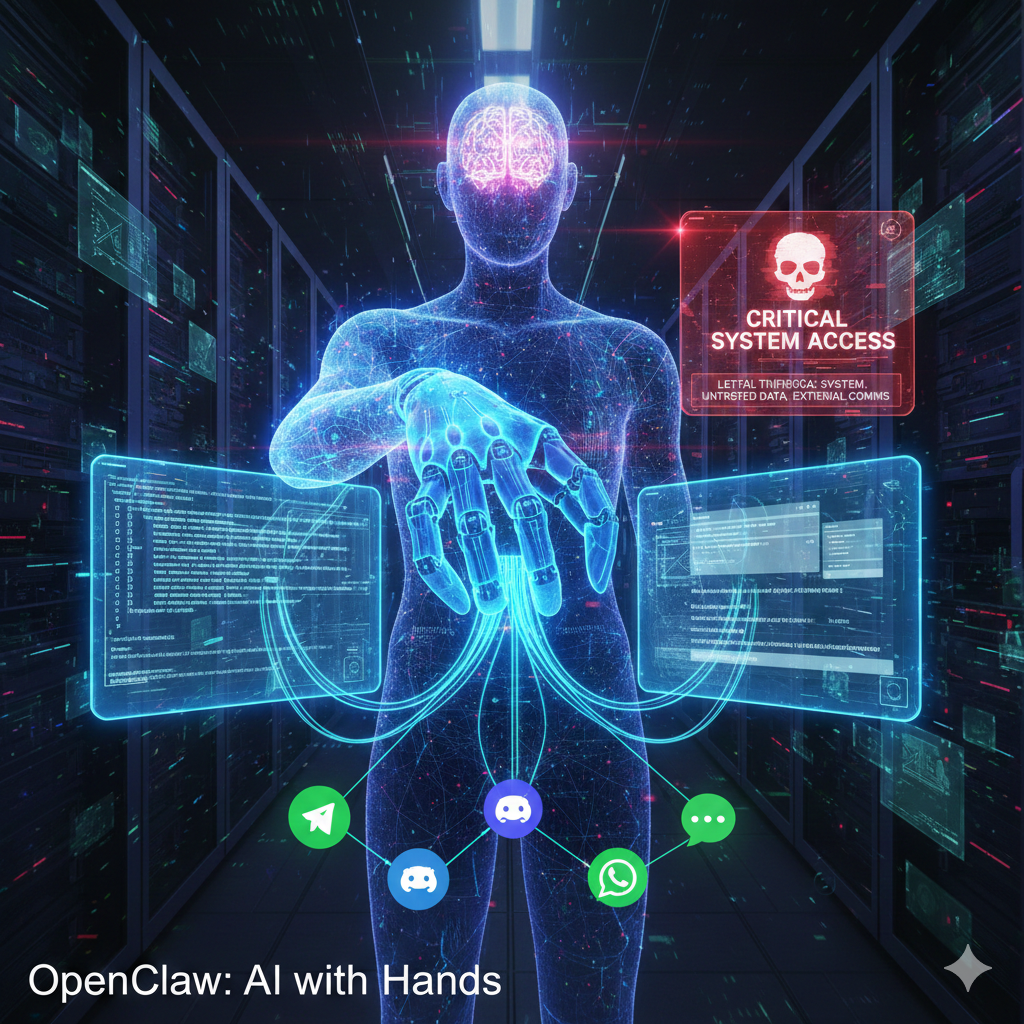
Featured article analysis: The Rise of OpenClaw: AI with Hands
OpenClaw, formerly known as Clawdbot and Moltbot, is a viral open-source autonomous AI agent developed by software engineer Peter Steinberger. Unlike traditional chatbots that merely respond to prompts, OpenClaw is designed as a “personal assistant with hands”, a long-running service that can execute real-world tasks across a user’s local machine and cloud services. It functions as a local gateway, connecting large language models (LLMs) like GPT-4 or Claude to a user’s files, terminal, and messaging platforms such as Telegram, Discord, and WhatsApp. By running locally on a user’s own hardware or virtual private server (VPS), it promises a level of data ownership and persistence that hosted AI services often lack.
The platform’s rapid ascent to over 150,000 GitHub stars by early 2026 is driven by its ability to perform proactive, agentic workflows, such as managing email inboxes, writing and executing code, and even negotiating purchases or booking reservations. However, its “where” and “how” are exactly what have put the cybersecurity community on high alert. Because OpenClaw often requires deep system access and root-level execution privileges to be useful, it effectively creates a highly privileged entry point into a user’s most sensitive data. Whether deployed on a home lab or a corporate workstation, a misconfigured OpenClaw instance can be reached via unencrypted channels, potentially exposing API keys and private conversation history to the public internet.
The “why” behind the intense security scrutiny lies in what researchers call the “Lethal Trifecta”: entrenched system-wide access, the ability to process data from untrusted sources (like incoming emails or web pages), and the power to communicate externally. This combination makes OpenClaw a prime target for indirect prompt injection, where an adversary can embed malicious instructions in a document or message that the agent then interprets as a legitimate command. For security enthusiasts, OpenClaw represents the ultimate double-edged sword: it is a masterpiece of productivity and a “shadow AI” nightmare that can bypass traditional input validation, serving as a powerful, autonomous backdoor if not strictly sandboxed and monitored
Projects
- TryHackMe -Training Impact on Teams – Complete
- TryHackMe – OWASP Top 10 2025: IAAA Failures – In Progress
Videos
Articles
- German Agencies Warn of Signal Phishing Targeting Politicians, Military, Journalists – Germany’s Federal Office for the Protection of the Constitution (aka Bundesamt für Verfassungsschutz or BfV) and Federal Office for Information Security (BSI) have issued a joint advisory warning of a malicious cyber campaign undertaken by a likely state-sponsored threat actor that involves carrying out phishing attacks over the Signal messaging app.
- Chinese cyberspies breach Singapore’s four largest telcos – The Chinese threat actor tracked as UNC3886 breached Singapore’s four largest telecommunication service providers, Singtel, StarHub, M1, and Simba, at least once last year.
- Fugitive behind $73M ‘pig butchering’ scheme gets 20 years in prison – A dual Chinese and St. Kitts and Nevis national was sentenced to 20 years in prison in absentia for his role in an international cryptocurrency investment scheme (also known as pig butchering or romance baiting) that defrauded victims of more than $73 million.
- Singapore Takes Down Chinese Hackers Targeting Telco Networks – The Singapore government disrupted cyber-attacks attributed to Chinese-nexus cyber threat group UNC3886 which targeted the country’s four telecommunications operators.
- European Commission discloses breach that exposed staff data – The European Commission is investigating a breach after finding evidence that its mobile device management platform was hacked. The Commission said on Friday that it detected traces of a cyberattack targeting infrastructure that manages its staff’s mobile devices.
- DPRK Operatives Impersonate Professionals on LinkedIn to Infiltrate Companies – The information technology (IT) workers associated with the Democratic People’s Republic of Korea (DPRK) are now applying to remote positions using real LinkedIn accounts of individuals they’re impersonating, marking a new escalation of the fraudulent scheme.
- North Korean hackers use new macOS malware in crypto-theft attacks – North Korean hackers are running tailored campaigns using AI-generated video and the ClickFix technique to deliver malware for macOS and Windows to targets in the cryptocurrency sector.
- Political Operative Sentenced to 48 Months in Federal Prison for Acting as Covert Agent of People’s Republic of China – Yesterday, a San Bernardino County man, Yaoning “Mike” Sun, 65, of Chino Hills, California, was sentenced by United States District Judge R. Gary Klausner for the Central District of California to 48 months in federal prison for acting as an illegal agent of the People’s Republic of China (PRC), including while serving as the campaign advisor for a political candidate who was elected to the city council of a Southern California city.
- Hackers Use Signal QR Codes to Spy on Military and Political Leaders – Hackers are using Signal QR codes and fake support scams to spy on military and political leaders, German security agencies warn.
- Police arrest seller of JokerOTP MFA passcode capturing tool – The Netherlands Police have arrested a a 21-year-old man from Dordrecht, suspected of selling access to the JokerOTP phishing automation tool that can intercept one-time passwords (OTP) for hijacking accounts.
- Windows 11 Notepad flaw let files execute silently via Markdown links – Microsoft has fixed a “remote code execution” vulnerability in Windows 11 Notepad that allowed attackers to execute local or remote programs by tricking users into clicking specially crafted Markdown links, without displaying any Windows security warnings.
- Google says hackers are abusing Gemini AI for all attacks stages – State-backed hackers are using Google’s Gemini AI model to support all stages of an attack, from reconnaissance to post-compromise actions.
- Apple Patches iOS Zero-Day Exploited in ‘Extremely Sophisticated Attack’ – Impacting the ‘dyld’ system component, the memory corruption issue can be exploited for arbitrary code execution.
- 83% of Ivanti EPMM Exploits Linked to Single IP on Bulletproof Hosting Infrastructure – A significant chunk of the exploitation attempts targeting a newly disclosed security flaw in Ivanti Endpoint Manager Mobile (EPMM) can be traced back to a single IP address on bulletproof hosting infrastructure offered by PROSPERO.
- Hacktivists, State Actors, Cybercriminals Target Global Defense Industry, Google Warns – Threat actors from Russia, China, North Korea and Iran have been observed launching attacks.
- Louis Vuitton, Dior, and Tiffany fined $25 million over data breaches – South Korea has fined luxury fashion brands Louis Vuitton, Christian Dior Couture, and Tiffany $25 million for failing to implement adequate security measures, which facilitated unauthorized access and the exposure of data belonging to more than 5.5 million customers.
- Dutch Carrier Odido Discloses Data Breach Impacting 6 Million – Hackers stole personal information such as names, addresses, and phone numbers from a customer contact system.
- Google Links China, Iran, Russia, North Korea to Coordinated Defense Sector Cyber Operations – Several state-sponsored actors, hacktivist entities, and criminal groups from China, Iran, North Korea, and Russia have trained their sights on the defense industrial base (DIB) sector, according to findings from Google Threat Intelligence Group (GTIG).