
Welcome to my weekly cybersecurity roundup! Here, I share updates on the projects I’m currently working on, along with the most insightful cybersecurity videos I watched, articles I found valuable, and podcasts I tuned into this week.
Featured Analysis
Featured article analysis: North Korea lures engineers to rent identities in fake IT worker scheme
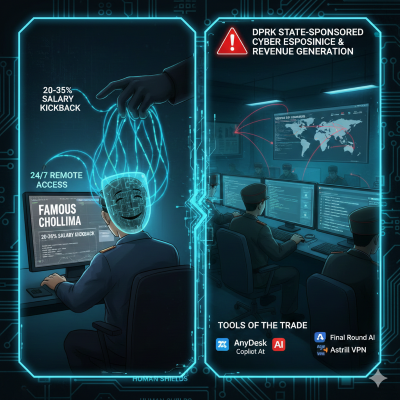
This article details an alarming intelligence operation by Famous Chollima (also known as WageMole), a component of North Korea’s state-sponsored Lazarus Group, which is actively recruiting legitimate engineers to rent their identities for illicit remote IT work. The core of the scheme involves luring developers with quick money, offering them 20% to 35% of a salary to act as a “figurehead” for a remote job at a targeted Western company, including Fortune 500 firms. By using the compromised engineer’s name, visa status, and PII, the DPRK agents can pass security screenings and secure remote positions. Crucially, the scheme often requires the engineer to grant 24/7 remote access to their computer, which serves as a proxy, masking the threat actor’s location and facilitating malicious activities, placing all legal and criminal risk squarely on the unsuspecting engineer.
The article highlights the sophisticated techniques and tools employed by the North Korean operatives, which were uncovered by security researchers Mauro Eldritch and Heiner García in a detailed honeypot operation. The researchers posed as a recruit to track the entire process, observing the use of AI-powered extensions like AIApply, Simplify Copilot, and Final Round AI to automate job applications, create resumes, and provide real-time, LLM-generated replies during technical interviews. Furthermore, the agents rely on tools like AnyDesk for remote access and Astrill VPN to conceal their geographical origin. By successfully trapping the agent in their sandboxed environment, the researchers gained access to the threat actor’s synchronized GMail inbox, revealing multiple aliases, job-seeking subscriptions, and details about the internal structure and competition within the six-member Famous Chollima team.
This investigation provides invaluable, real-world intelligence for corporate defenders, offering an early warning of a persistent and evolving threat vector. The DPRK’s strategy of leveraging legitimate identities to infiltrate global enterprises for espionage and revenue generation is a significant cybersecurity challenge that goes beyond traditional malware-based attacks. The information gathered including the specific tools, social engineering tactics, and the names used by the operatives allows organizations to move beyond standard Indicators of Compromise (IoCs) and implement stronger detection and disruption strategies. This detailed exposure of the fake IT worker scheme underscores the critical need for robust HR/recruitment vetting processes and comprehensive system monitoring to prevent nation-state actors from establishing a persistent presence within Western corporate networks.
Projects
- TryHackMe – Advent of Cyber
Articles
- University of Pennsylvania confirms new data breach after Oracle hack – The University of Pennsylvania (Penn) has announced a new data breach after attackers stole documents containing personal information from its Oracle E-Business Suite servers in August.
- Fake Calendly invites spoof top brands to hijack ad manager accounts – An ongoing phishing campaign impersonates popular brands, such as Unilever, Disney, MasterCard, LVMH, and Uber, in Calendly-themed lures to steal Google Workspace and Facebook business account credentials.
- North Korea lures engineers to rent identities in fake IT worker scheme – In an unprecedented intelligence operation, security researchers exposed how North Korean IT recruiters target and lure developers into renting their identities for revenue generation.
- Freedom Mobile discloses data breach exposing customer data – Freedom Mobile, the fourth-largest wireless carrier in Canada, has disclosed a data breach after attackers hacked into its customer account management platform and stole the personal information of an undisclosed number of customers.
- Stealthy browser extensions waited years before infecting 4.3M Chrome, Edge users with backdoors and spyware – And some are still active in the Microsoft Edge store
- Record 29.7 Tbps DDoS Attack Linked to AISURU Botnet with up to 4 Million Infected Hosts – Cloudflare on Wednesday said it detected and mitigated the largest ever distributed denial-of-service (DDoS) attack that measured at 29.7 terabits per second (Tbps).
- Contractors with hacking records accused of wiping 96 govt databases – U.S. prosecutors have charged two Virginia brothers arrested on Wednesday with allegedly conspiring to steal sensitive information and destroy government databases after being fired from their jobs as federal contractors.